
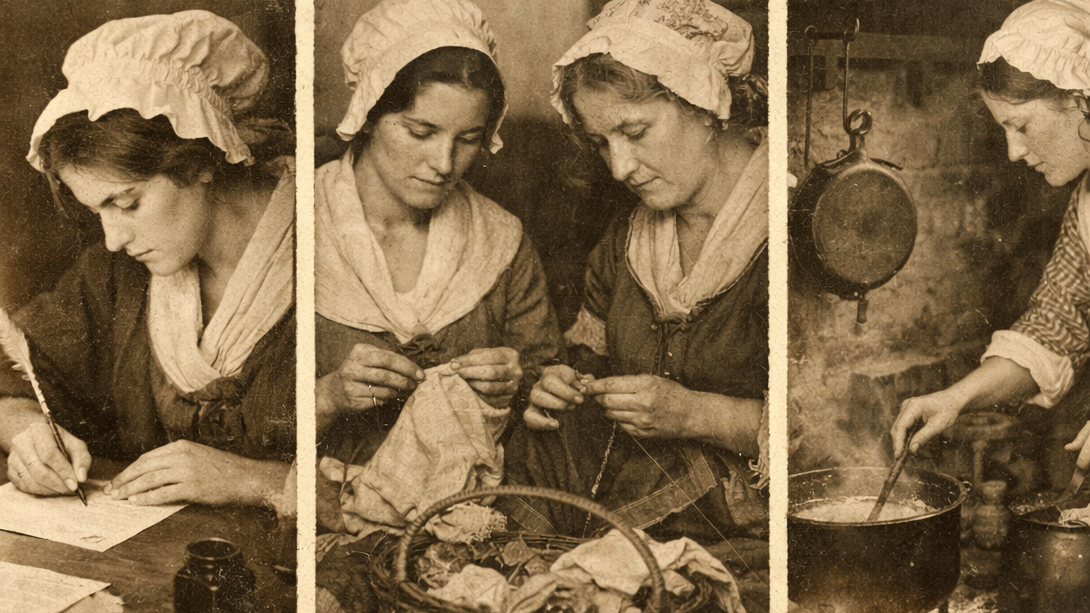
“Most people throughout the colonies experienced the American Revolution not on the field of battle, but in their households, neighborhoods, and communities,” said Karsh Institute Gibson Fellow in Democracy Lauren Duval, whose new book, The Home Front: Revolutionary Households, Military Occupation, and the Making of American Independence, explores daily life during the American Revolution.
In this telling, Duval chronicles how the war, which lasted from 1775 to 1783, was lived as much in private spaces as in public ones, reminding us that the nation’s foundations were forged not only by generals and statesmen, but by civilians navigating occupation, scarcity, divided loyalties, and uncertainty.
Duval, who will discuss her book at the Karsh Institute of Democracy on March 26 for “Touchstones of Democracy: Home”—in conversation with Jane Kamensky, president of Thomas Jefferson’s Monticello—talked with us recently about what she learned while writing the book and how the day-to-day struggles of regular civilians truly helped shape our nation.
Q: What was the most surprising insight you uncovered about how the war affected ordinary people’s lives?
Duval: When most people think of the American Revolution, two things tend to come to mind: the first is a war that was fought on battlefields; the second is the political contest between loyalists and revolutionaries.
But for many civilians, most of whom had little experience with active warfare, this was a terrifying, often traumatic experience. It upended their daily life to an unprecedented degree. It, quite literally, brought the war home. Amid the chaos of war and occupation, most people were far more concerned with protecting their family, their property, and their loved ones than they were with adherence to political principles.
The Revolution was a terrifying, often traumatic experience. It upended their daily life to an unprecedented degree. It, quite literally, brought the war home.
Q: How, then, did civilians navigate such instability?
Duval: There was a great deal of flexibility and pragmatism. I find these stories quite compelling, because they show us how ordinary people endured the extraordinary circumstances of the American Revolution. They remind us that history occurs in not just grand, significant moments—on battlefields or in the halls of Congress—but also in quiet, quotidian spaces.
Q: How do these everyday experiences connect to larger questions about democratic ideals and institutions during this era?
Duval: War brought widespread devastation, property destruction, troop requisitioning, the quartering of British officers, and an unprecedented disruption to daily life that undermined men’s legally recognized control of their households. And in occupied cities, where civilians lived under martial law, this meant that men were not in charge of their households—the British army was.
This disruption to domestic life altered the power dynamics in the home in significant ways. Those who were traditionally subordinated—white women, domestic servants, and enslaved people—were able to exert new levels of influence. Examining the war through their experiences underscores the varied, frequently contradictory understandings of liberty and freedom in this moment.
Q: How did these disruptions shape the values and political structures of the new nation?
Duval: In the aftermath of a brutal civil war that threw domestic life into chaos, many people wanted nothing more than to be with their families and feel safe and protected. In the early republic, these sentiments became deeply entwined with national identity and values. The laws of the new nation erected legal protections around property and bolstered men’s control over their households.
The safe, protected household came to symbolize the values for which the war had been fought and won. These developments linked households and the rights that they safeguarded to the nascent state. But it is only in analyzing the daily, intimate experiences of war that we can begin to understand the deeply personal roots of these political developments.
The safe, protected household came to symbolize the values for which the war had been fought and won.
Q: Did these political developments come into tension with commitments to the household and family?
Duval: Decisions about whether to cooperate with occupying forces, resist them, or attempt neutrality were rarely abstract ideological choices. They were deeply embedded in efforts to protect loved ones and preserve household stability.
When male household heads found their authority undermined by military occupation, it destabilized long-standing assumptions about governance and power. If a man’s authority in his own home could be displaced by an external force, what did that mean for political authority more broadly?
These tensions shaped emerging understandings of citizenship as something rooted not only in political participation, but in the ability to safeguard one’s household and dependents. Civic responsibility became intertwined with the restoration of domestic order.
Q: You drew on a wealth of primary sources to bring this book to life. How do you think this helps contemporary readers think about democracy today?
Duval: Primary sources and narrative histories can really convey the messiness and the uncertainty of the Revolution for the people who lived through it. It can help humanize this big, important moment in ways that feel relatable and accessible.
For the many varied people who lived through the Revolution, the pursuit of life, liberty, and happiness were not just abstract ideals, nor did they mean the same thing to everyone. By looking at letters and diaries and newspapers, we see, again and again, diverse people choosing to pursue these aims for themselves and their loved ones, even amid a moment of great danger, violence, and uncertainty. This, I think, is something that is relatable and can offer both hope and a path forward in this moment.
By looking at letters and diaries and newspapers, we see, again and again, diverse people choosing to pursue these aims for themselves and their loved ones, even amid a moment of great danger, violence, and uncertainty.
Q: In researching this book, what did you learn about daily life during the Revolution that most challenged your understanding of the era?
Duval: One of the things that The Home Front tries to do is allow readers to experience the American Revolution from the perspective of those who lived through it—placing them in the streets flooded with British soldiers and in the households where ordinary people navigated the disruption of occupation.
By centering these experiences, the book offers a new perspective that highlights how fully the experience of the American Revolution was entwined with daily concerns and domestic life. It played out in what people bought in the market, where they felt safe, how they moved through their city, and how they supported and protected their family, friends, and neighbors as unprecedented violence descended upon their communities.
Read more about the Karsh Institute’s work around the 250th anniversary of the American experiment.