
Early last fall, a group of K–12 civics teachers and educators from the City of Charlottesville and Albemarle County gathered in a circle on the floor. They were reflecting on what they had learned during the first day of the Karsh Institute’s Educating for Democracy Fellowship, a year-long program designed to help educators cultivate classrooms where students learn about democracy and see themselves as participants in an ongoing democratic experiment.
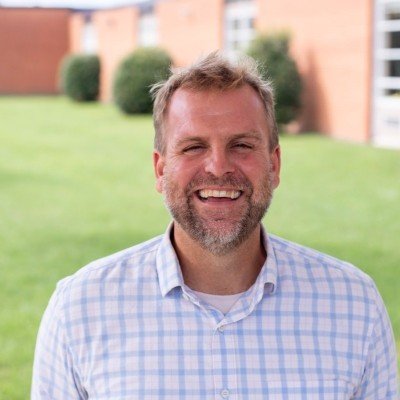
“It was a small but meaningful moment,” recalled John Hobson, co-lead of the program and the principal of Joseph T. Henley Middle School in Albemarle County. “The way you organize a classroom shapes how students experience it. When a teacher gets down on the floor with students, it can level the playing field and signal that everyone has a voice. That's one way democratic classrooms operate.”
Launched in the lead-up to the 250th anniversary of the Declaration of Independence, the fellowship brought educators together to explore new approaches to teaching civics and social studies while helping students understand the nation’s history, democratic ideals, and ongoing civic challenges.

“Anniversaries naturally invite us to reflect on our history—who we are as a nation, how we got here, and what we want our future to look like,” said Lauren Duval, an assistant professor at the University of Oklahoma who is the other co-lead of the program, which she developed as a David and Linda Gibson Postdoctoral Fellow in Democracy at the Karsh Institute. “For educators, the 250th is especially exciting because it has generated an extraordinary amount of new scholarship, public programming, and educational resources.”
“Anniversaries naturally invite us to reflect on our history—who we are as a nation, how we got here, and what we want our future to look like.”
As the program concludes, participants are developing curriculum units that will be shared with other educators, extending the program’s impact beyond the original cohort.
“The goal was to translate current scholarly conversations into practical classroom tools,” said Duval, a former high school history teacher. “Just as important, the fellowship has given educators space to work through those ideas together—to discuss what would be most useful in their classrooms, think about how to frame different topics, and learn from one another in a collaborative environment.”
“The fellowship has given educators space to discuss what would be most useful in their classrooms, think about how to frame different topics, and learn from one another in a collaborative environment.”
The program—inspired by the national Educating for American Democracy initiative, which Monticello president Jane Kamensky helped shape and which aims to “prepare knowledgeable and motivated citizens to participate in American self-government”—leveraged Charlottesville’s unique concentration of scholars and historic institutions, connecting teachers with the area’s experts.
“We're incredibly fortunate in Charlottesville to have access to institutions like Monticello, UVA, and the many scholars who visit,” Duval said. “We're all engaged in the same work, so it has been wonderful to give K–12 teachers opportunities to connect with academics, primary sources, and new research.”
For Burley Middle School seventh grade social studies teacher Sindhu Vadlamani, the program reshaped both her teaching and her perspective on American democracy.

“This experience has been transformative for my teaching practice and my own personal relationship with this country,” Vadlamani said. “By attending the Karsh Institute’s ‘Touchstones of Democracy’ event series this year, I was able to learn from experts about the origins of our nation while thinking about how to transfer that knowledge to my students.”
The Educating for Democracy Fellowship was focused on helping teachers like Vadlamani move beyond a simple narrative of the American founding.
“One of the most important developments in current scholarship is studying the Revolution through many different voices,” Duval said. “It reminds us that there was never a single story of the American founding.”
Instead, she said, students should understand the many perspectives that have shaped American democracy and recognize it as an unfinished project that each generation helps carry forward.
“Since the Revolution, Americans have continued to strive to make real the promises of equality and of life, liberty, and the pursuit of happiness,” Duval added. “It’s important for students to understand that democracy wasn't completed in 1776. It’s something each generation continues to shape.”
“It’s important for students to understand that democracy wasn't completed in 1776. It’s something each generation continues to shape.”
For the educators who are participating, that lesson also shaped how they thought about their classrooms. They discussed focusing not only on civics but also on how students can bridge disagreements throughout their lives, encouraging respectful dialogue and learning from others who hold beliefs different than their own.

“As we build our classroom communities, we must normalize difference—not only difference in identity, but also in ideology,” said Russell Carlock, an educational and research data scientist and Early College Scholars teacher for Albemarle County Schools. “This is challenging, especially when there is conflict between one person’s identity and another person’s ideology. If we do not build the tools to navigate this in our public schools, the future populace of our democracy will have little defense against the new media landscape that feeds on division and outrage.”
For many, the fellowship also has reshaped how they understand democracy and their own role as educators.
“This program has changed how I teach and sparked my curiosity again for learning,” Vadlamani said. “It has given me a framework to process how delicate yet durable our democracy is, and how I can better recognize the other moments of rupture and repair that our country has been through.”